Microspikes vs. Crampons: Which Winter Traction Do You Actually Need?
Key takeaways
- Microspikes handle packed snow and ice on rolling trails, which covers most winter hiking in Maine.
- Crampons are for steep, hard ice and mountaineering, and they need a stiff boot to work safely.
- Nanospikes and EXOspikes are the lighter, road-friendly end of the range, built for pavement and moderate trails.
- Traction type matters less than matching the device to the terrain and the boot you already own.
- Carry them before you need them. The icy stretch usually appears well before the summit.
The first icy descent of the season is when most people realize their boots alone are not enough. The traction wall at a gear shop does not make the choice easier: microspikes, nanospikes, EXOspikes, hiking crampons and full mountaineering crampons all promise grip, and they are not interchangeable. Here is how to tell which one your winter actually calls for.
What is the difference between microspikes, nanospikes and crampons?
Microspikes use short steel spikes on chains that stretch over a boot, built for packed snow and ice on rolling trails. Nanospikes use smaller studs in a flat plate, built for pavement and hard-packed surfaces. Crampons use long, rigid points that bite into steep ice, and they require a stiff or fully rigid boot to be safe.
| Type | Spike length | Best surface | Boot needed |
| Nanospikes | Very short studs | Icy roads, packed paths, running | Any shoe or boot |
| EXOspikes | Short carbide spikes | Road to trail, mixed winter surfaces | Any shoe or boot |
| Microspikes | 12 steel spikes on chains | Packed snow, trail ice, rolling terrain | Any sturdy boot |
| Hiking crampons | Longer points, 10 to 12 | Firm snow, moderate slopes | Stiffer hiking boot |
| Mountaineering crampons | Full rigid points | Steep and vertical ice | Stiff or rigid mountaineering boot |
The pattern is simple. As the spikes get longer and the frame gets stiffer, the device handles steeper and harder ice, and it demands more from the boot underneath it.
One thing none of them do is float. Every device here is built to bite into a hard surface, so once the snow gets deep and soft enough that you are sinking to your shins, traction stops being the problem and flotation starts. That is snowshoe territory, and our beginner's guide to snowshoeing covers where that line falls. Plenty of Maine winters ask for both in the same week.

When microspikes are the right call
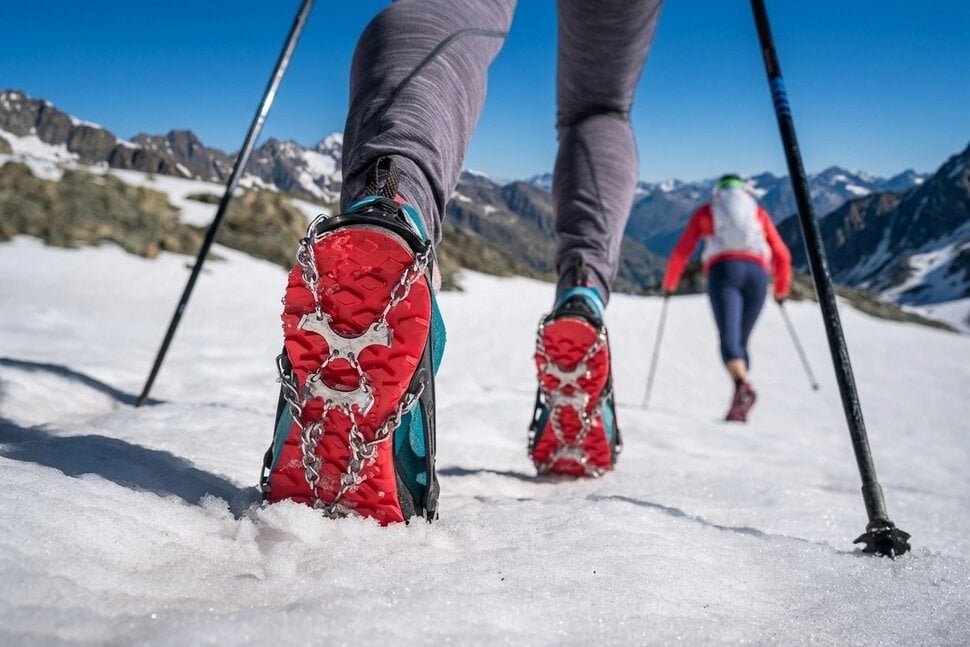
Microspikes are the default for winter hiking in New England, and it is not close. The Kahtoola MICROspikes we stock use twelve stainless steel spikes on welded chains, weigh 13.5 ounces, and stretch over whatever boot you already own. They pack down into a tote sack small enough to live in a daypack all season.
That combination is what makes them the workhorse. On a trail that alternates between bare rock, packed snow and glare ice, which describes most of an Acadia winter, you want something you can pull on in thirty seconds and forget about. The harness stays elastic down to minus 22 degrees, so they still go on when your hands are cold and the temperature has dropped.

Where nanospikes and EXOspikes fit
Nanospikes and EXOspikes solve a different problem. Their studs are shorter and set into a flatter plate, which means they grip icy pavement without the awkward rolling feel that longer spikes have on hard surfaces. For winter road running, dog walks on a frozen sidewalk, or a commute across an ice-glazed parking lot, they are the better tool.
They are also more comfortable across long stretches of bare ground. If your route is half plowed road and half packed trail, the shorter profile stops you from clanking over rock. Where they run out of capability is deeper snow and steeper ground, which is exactly where microspikes take over.
When you actually need crampons
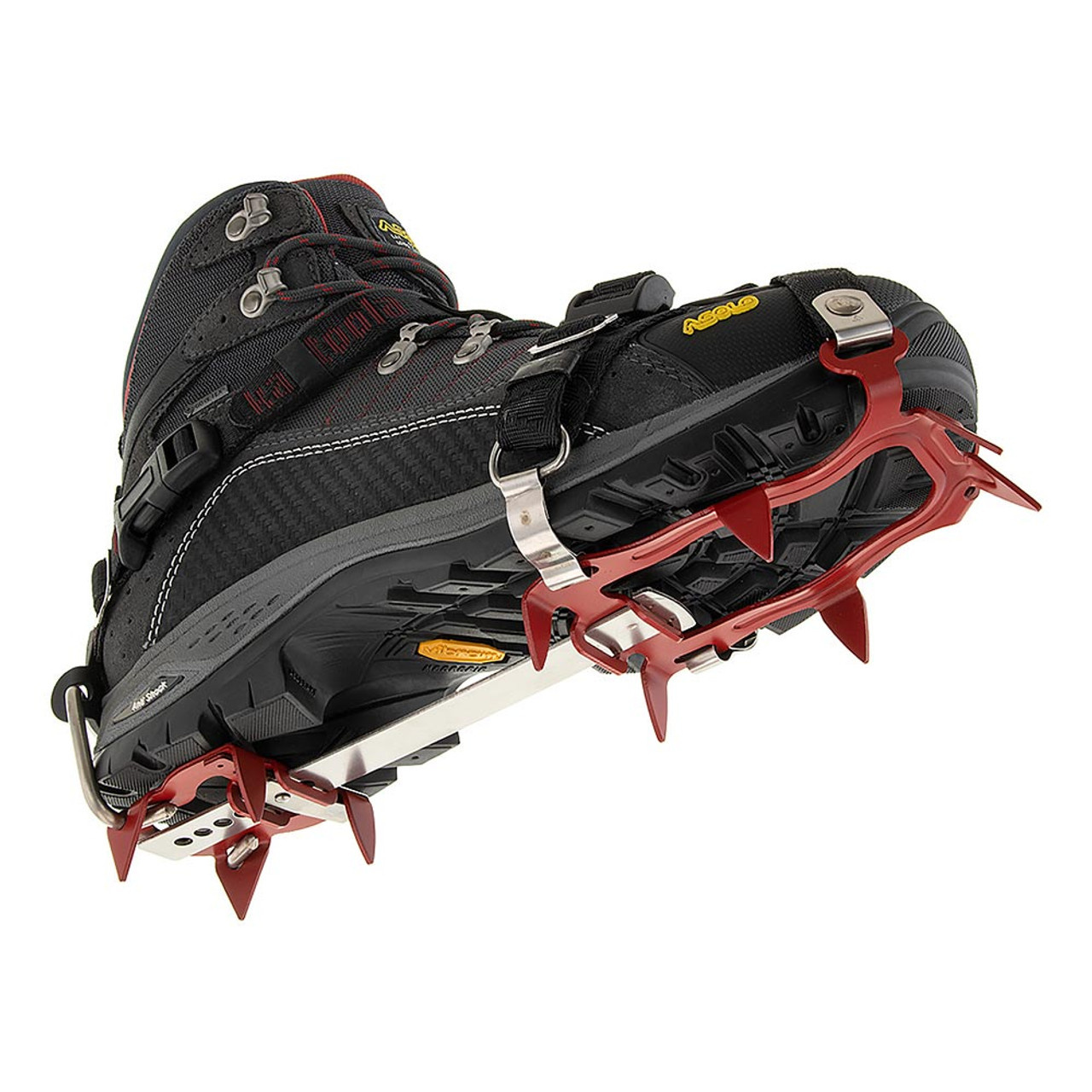
Crampons are a different category, not an upgrade. They are built to bite into firm snow and hard ice on terrain steep enough that a slip has consequences, and they only work properly with a boot stiff enough to hold them without flexing. Strapping aggressive crampons to a soft trail runner is unsafe, because the boot bends, the points lever loose, and the connection you are trusting your footing to fails.
For most Maine winter hiking, you will not need them. They become the right choice on technical ground: ice climbing, alpine routes, and steep snow slopes where self-arrest is part of the plan. If that is where you are heading, our crampons and mountaineering boots need to be chosen together rather than separately.
What Maine's winter trails actually ask for
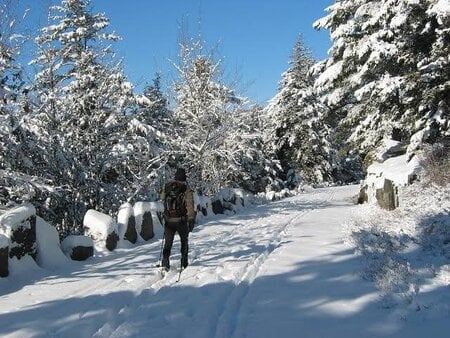
Terrain here changes faster than the gear list suggests. Acadia's carriage roads are mostly rolling and packed, which is microspike ground almost all winter. The summit trails on Cadillac and Dorr are a different story once the wind scours them: bare granite slabs go to sheet ice, and the exposure means a slide has somewhere to go. That is still microspike terrain for most people, but it is where the decision starts to matter.
Head inland toward Katahdin or into the Whites, and the calculation changes again. Steeper sustained slopes, harder refrozen snow, and longer days above treeline are where hiking crampons earn their place. The honest answer for most Maine hikers is one pair of microspikes bought early, with crampons added only when the objective genuinely calls for them.
What about the cheap cleats from the hardware store?
They have a place, and it is a narrow one. The coiled-wire and small-stud cleats sold at hardware stores work reasonably well on a flat icy driveway or a short walk to the mailbox. They are not built for trail use, and the failure mode is what makes them a poor trail choice: the rubber harness tends to stiffen and split in real cold, and once one side lets go, you are walking on ice with a flapping piece of rubber attached to one boot.
The practical difference is the harness material and the spike mounting. A trail-grade device uses a thermoplastic elastomer harness that stays flexible well below zero, with reinforced eyelets where the tension actually goes. That is what you are paying the difference for, and it is the part that matters when you are two miles from the car.
Getting the fit right and carrying them
Traction devices are sized to your footwear, not your foot, so bring the boots you plan to wear. A device that fits a bulky insulated boot may be loose on a trail runner, and a loose harness will roll off mid-stride at the worst moment.
Carrying them matters as much as owning them. The icy section almost never waits until you are ready, and stopping to put spikes on is far easier than trying to reverse down something you should not have started. Most trail-grade devices come with a tote sack for a reason: chains and spikes will shred the inside of a pack if you throw them in loose.
Maintenance is minimal but not optional. Rinse them in lukewarm water after a salty road walk, since road salt corrodes steel faster than anything you will meet on a trail, and let them air dry rather than putting them near a heat source. Check the harness for splits and the eyelets for tearing before each season, because those are the parts that fail, not the spikes. Replacement sacks and gaiters live in our ice and snow accessories section.
Pair them with the right winter hiking boots, and if you are choosing between spikes and simply changing footwear, our post on MICROspikes versus trail running shoes covers that trade-off for shoulder-season conditions. Traction also happens to be one of the better gifts for a Maine hiker, which is why it appears in our gift guide. Browse the full Snow & Ice range, or come try a pair on at the Bangor or Bar Harbor store.
FAQ
Can you use microspikes instead of crampons?
On rolling trails, packed snow and general winter hiking, yes, and microspikes are usually the better choice. On steep, hard ice where a fall would slide, they are not a substitute for crampons.
Do microspikes work on regular hiking boots?
Yes. Microspikes stretch over almost any sturdy boot or shoe. Crampons are the ones that require a stiffer, compatible boot.
When should you put traction on during a hike?
Before you need it. Put them on at the bottom of an icy stretch rather than partway up, since the hardest place to stop and fit them is in the middle of the ground you are worried about.
Leave a comment
Recent articles
View all
Merino vs. Synthetic Base Layers for Winter Hiking