Women's Hiking Boot Sizing Guide: Why You Need Different Sizing Than Men's

Buying hiking boots online is stressful enough. Add confusing size charts, brand-specific sizing quirks, and the question of whether to just grab a men's pair — and it gets overwhelming fast. If you've ever ordered what looked like the right size and ended up with blisters, heel slippage, or pinched toes on the trail, you're not alone.
This guide breaks down everything you need to know about women's hiking boot sizing so you can order online with actual confidence — and hit the trail without second-guessing your footwear.
Why Women's Boot Sizing Isn't Just "Smaller Numbers"
Here's a common misconception: women's hiking boots are simply men's boots in smaller sizes with different colors. They're not. Women's-specific boots are built around a different foot last — the 3D mold the shoe is constructed on.
Women's feet tend to have narrower heels, a higher arch, and a wider forefoot relative to overall foot length. Men's lasts don't account for these differences. A women's size 8 and a men's size 6 (the approximate conversion) are not the same shoe — one is designed for a woman's foot, the other is not.
Wearing a men's last on a women's foot often means:
- Heel slippage (the heel cup is too wide)
- Arch discomfort (the arch hits in the wrong spot)
- Toe box issues (too much room up front, not enough lateral support)
If you've been tolerating any of those issues and assuming that's just "how hiking boots feel," it's worth trying a true women's-specific design.
Understanding Size Conversion: US, UK, EU, and Brand-Specific Sizing
Most hiking boot brands use US sizing for their primary market, but they'll also list UK and EU sizes. Here's a general conversion to keep in mind:
- US Women's 7 ≈ UK 5 ≈ EU 38
- US Women's 8 ≈ UK 6 ≈ EU 39
- US Women's 9 ≈ UK 7 ≈ EU 40
- US Women's 10 ≈ UK 8 ≈ EU 41–42
These are approximations. The frustrating reality is that a Salomon size 8 and a Merrell size 8 are not necessarily the same fit. Brands use their own proprietary lasts, which is why you'll hear experienced hikers say things like "I'm a 9 in Oboz but an 8.5 in Salomon."
Always check the brand's own size chart — and when in doubt, read recent customer reviews specifically mentioning fit and sizing.
The Half-Size Dilemma: When to Size Up or Down for Hiking
This is one of the most common questions we hear at the shop, and the honest answer is: it depends on what you're doing.
Size up if you:
- Have wide feet or a wide forefoot
- Plan to wear thicker hiking socks (merino wool, midweight cushion)
- Are hiking on steep descents where feet slide forward
- Have one foot slightly larger than the other (fit to the larger foot)
Size down or stay true to size if you:
- Are between sizes and have a narrow heel
- Plan to wear thin liner socks
- Need a snug, precise fit for technical terrain
A good rule of thumb: there should be about a thumb's width of space between your longest toe and the end of the boot. Your heel should feel locked in with minimal lift when you walk on flat ground.
Width Matters: How to Determine if You Need Wide, Narrow, or Standard
Most hiking boots come in standard (medium/D) width as the default. But width fit matters just as much as length — maybe more, actually.
Signs you might need a wider fit:
- The sides of your feet press against the boot walls
- You get numbness or tingling across the forefoot after an hour
- You have bunions or a wide ball-of-foot
Signs you might need a narrower fit:
- Your foot slides side to side inside a standard width
- You tend to lace boots very tightly to compensate
- You have a narrow heel combined with a narrow forefoot
Not all brands offer wide widths in women's styles, but some do. When in doubt, ask — our staff can point you toward brands known for accommodating different widths.
Measuring Your Feet at Home: Step-by-Step Guide for Accurate Sizing
Foot size changes over time. Pregnancy, age, and even spending more time on your feet can affect length and width. If you haven't measured your feet in a few years, do it now — especially before buying boots online.
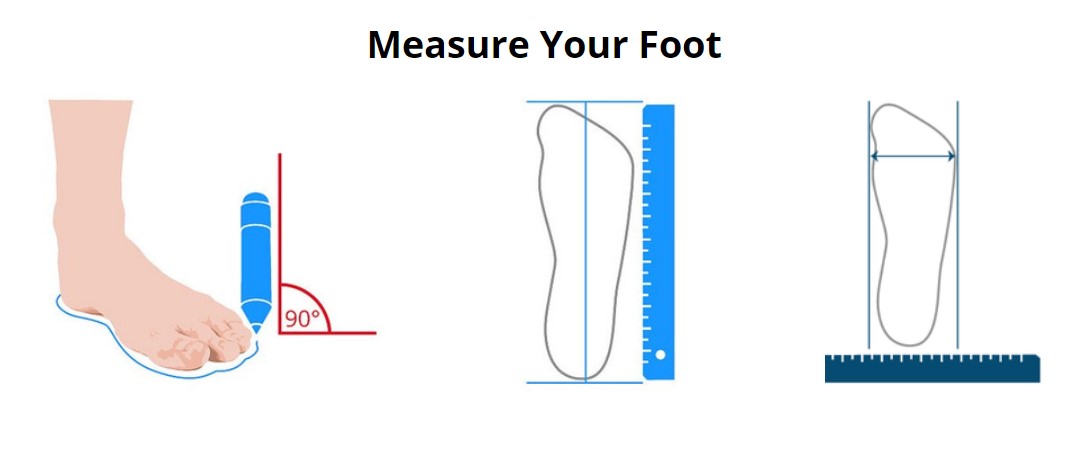
What you need: A piece of paper, a pen, and a ruler or measuring tape.
- Step 1: Place the paper on a hard floor and stand on it with your full weight. Sitting changes your foot shape.
- Step 2: Trace your foot with the pen held vertically (perpendicular to the floor, not angled).
- Step 3: Measure the longest point (heel to longest toe) and the widest point (ball of foot).
- Step 4: Do both feet. Use the larger measurement to determine your size.
- Step 5: Measure in the afternoon or evening — feet swell throughout the day, and hiking boots will be worn at those times.
Compare your measurements to the brand's size chart, not just general conversion tables.
Brand-Specific Sizing Differences (Oboz vs. Salomon vs. Merrell)
Here's a quick breakdown of how the most popular brands in our women's hiking shoe collection tend to fit:
Oboz
Generally runs true to size. Known for a slightly wider toe box and a secure heel hold. Good choice for standard to slightly wide feet.
Salomon
Often runs a half-size small, especially in their low-cut trail shoes. Fits snugger through the midfoot. Better suited for narrow to medium feet.
Merrell
Sizing is generally true to size, with a medium-width fit. Their Moab series has a slightly roomier toe box — a good starting point if you're between brands.
When you're shopping our women's footwear collection, product pages will usually include sizing notes from the brand. Read those carefully — they're there for a reason.
Common Sizing Mistakes Women Make (and How to Avoid Them)
- Ordering based on street shoe size only. Hiking boots often fit differently than sneakers. Measure your feet and check brand charts.
- Forgetting to account for sock thickness. Try boots with the socks you actually plan to hike in. Check out our women's hiking socks for thickness options.
- Assuming one foot is dominant. Most people have one foot slightly larger. Always fit to the bigger foot.
- Buying tight because "they'll break in." Modern hiking boots don't require painful break-in periods. A well-fitting boot should feel comfortable from day one — snug but not constricting.
- Ignoring heel lift. A little movement is normal. Consistent heel slippage means the boot is too big or too wide at the heel — and that means blisters.
Online Buying Confidence: Ordering the Right Size Without Trying On
Buying boots online without trying them on is genuinely doable — here's how to set yourself up for success:
- Measure your feet fresh (not from memory, and not from years ago)
- Check the brand's specific size chart for the model you're buying
- Read recent reviews filtered to mentions of "fit," "sizing," or "runs small"
- Know your width — standard, wide, or narrow
- Order the socks you plan to hike in first, and factor their thickness into the size
Still unsure? Our team at Alpenglow's Bangor and Bar Harbor locations can help you figure out your fit over the phone or in person — just reach out.
Ready to find your fit? Shop women's hiking boots and shoes at Alpenglow — and if you're heading out on backpacking trips, don't miss our women's backpacking shoes collection as well.
Leave a comment
Recent articles
View all