Snowshoe Binding Systems Explained: Strap vs. BOA vs. Ratchet Comparisons
The binding system on your snowshoes represents the critical interface between your boots and the snowshoe platform, directly affecting comfort, security, ease of use, and overall performance throughout your winter adventures. While many snowshoe shoppers focus heavily on frame design, traction systems, and flotation capabilities, the binding system you choose dramatically impacts your daily experience on the trail—from the first moment you step into your snowshoes in a cold parking lot to the last mile of a long day when fatigue sets in and simple adjustments become challenging with numb fingers.
Understanding the fundamental differences between traditional strap bindings, innovative BOA closure systems, and efficient ratchet mechanisms empowers you to select snowshoes with binding systems that match your priorities, typical conditions, and personal preferences. This comprehensive guide explores each binding type in depth, examining their advantages, limitations, and ideal applications to help you make informed decisions about this often-overlooked but critically important component of snowshoe performance.
The Critical Role of Snowshoe Bindings
What Makes a Good Binding System?
Before diving into specific binding types, it's essential to understand what characteristics define excellent binding performance. The ideal snowshoe binding securely attaches your boot to the snowshoe platform without pressure points or uncomfortable constriction, accommodates quick entry and exit even in cold conditions with gloved hands, allows on-trail adjustments without removing snowshoes, maintains consistent tension throughout the day without loosening, and accommodates various boot types and sizes if multiple users will share the snowshoes.
Different binding systems prioritize these characteristics differently, creating distinct user experiences and performance profiles. No single binding type excels universally across all criteria—each involves trade-offs that matter more or less depending on your specific snowshoeing style, conditions, and preferences.
Binding Components and Terminology
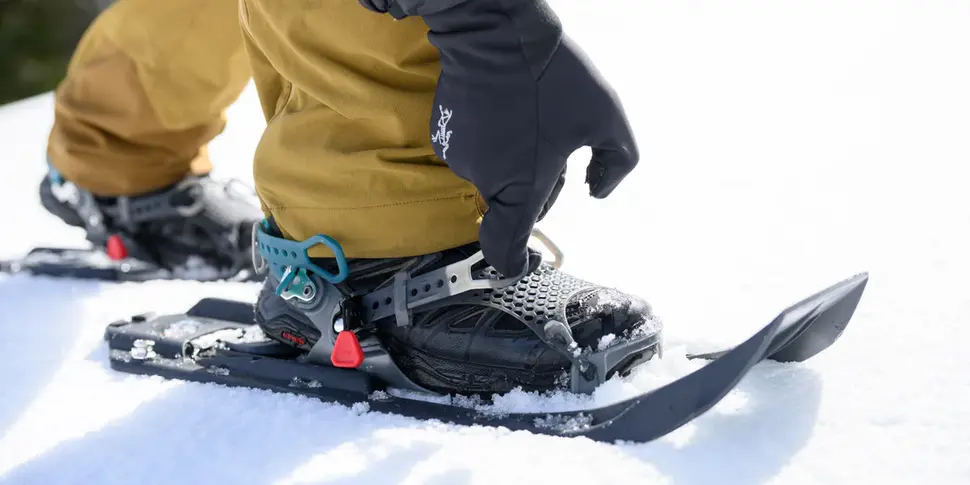
Most snowshoe bindings consist of several key components regardless of closure mechanism. The toe box or toe cup cradles the front of your boot, providing a reference point and preventing forward sliding. The heel strap secures the back of your boot, preventing lift during the swing phase of your stride. The instep or over-foot closure system—where binding types differ most dramatically—secures the middle of your boot, providing the primary attachment force. The decking or platform that these components attach to must withstand the forces generated during snowshoeing without flexing or failing.
Understanding these components helps you evaluate how different binding systems execute these functions and where design differences create meaningful performance variations.
Traditional Strap Binding Systems
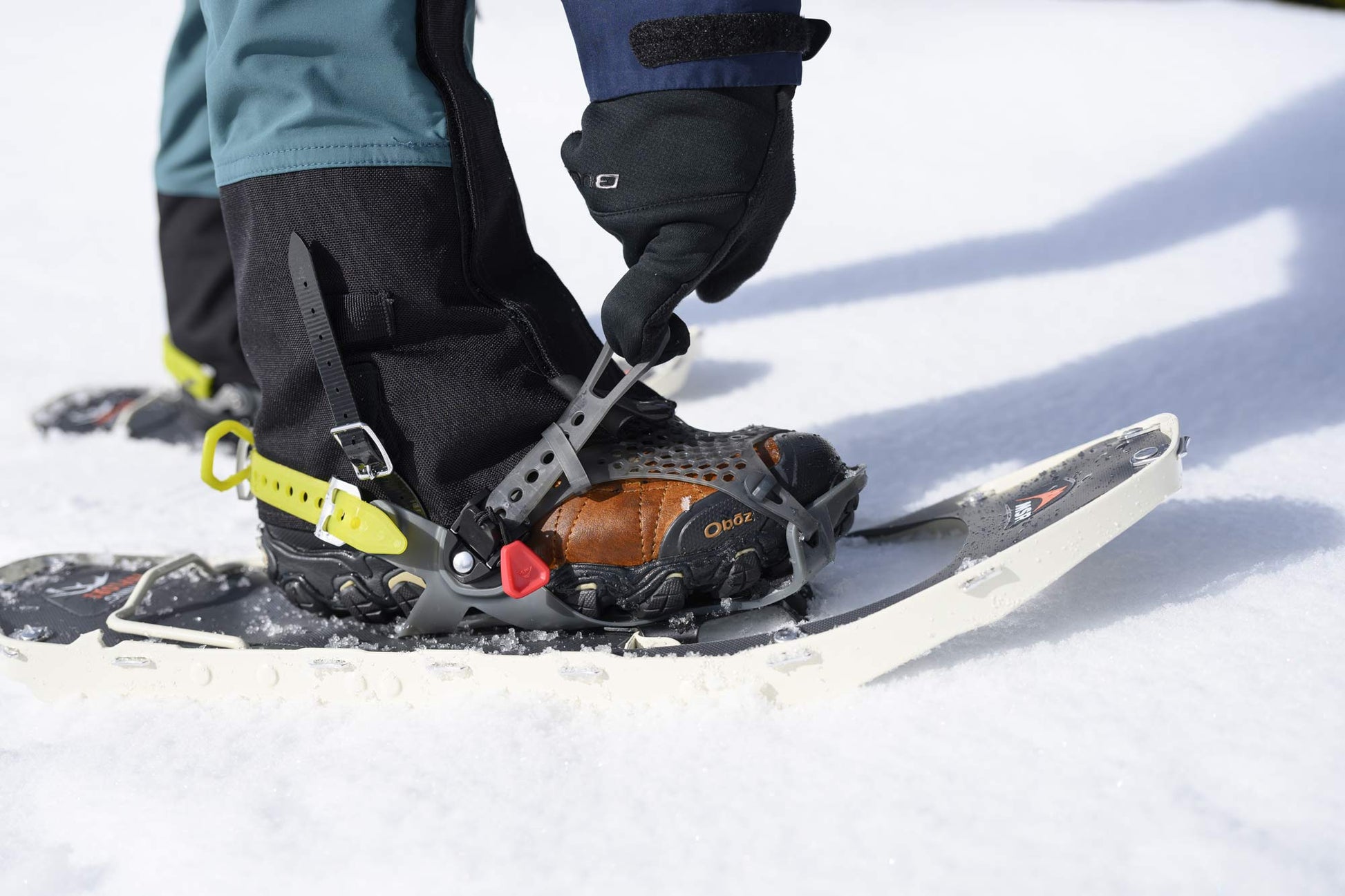
Design and Function
Traditional strap bindings—the original and still most common snowshoe binding type—employ simple webbing straps with buckles, typically featuring three primary straps: a toe strap across the front of your boot, an instep strap over the top of your boot, and a heel strap around the back. You tighten these straps by pulling webbing through buckles and securing the excess, creating mechanical advantage that cinches your boot securely to the snowshoe.
The simplicity of strap bindings has kept them relevant despite newer technologies. There are no complex mechanisms to fail, no proprietary parts to replace if something breaks, and the straightforward design is intuitive even for first-time users. Many recreational and mid-range snowshoes continue using strap systems because they work reliably at minimal cost.
Advantages of Strap Bindings
Simplicity and Reliability: Strap bindings have virtually nothing that can malfunction. The webbing itself is extremely durable, and buckles are simple mechanical devices that rarely fail. In cold conditions where complex mechanisms might freeze or become difficult to operate, straps continue functioning normally.
Universal Boot Compatibility: Strap bindings accommodate wildly varying boot sizes and types through their adjustable nature. The same snowshoes can fit someone wearing lightweight hiking boots and another person wearing bulky insulated winter boots—simply adjust strap lengths accordingly. This versatility proves valuable for families sharing equipment or rental operations serving diverse users.
Field Repairability: If a strap breaks in the backcountry, repairs are straightforward with basic materials many winter travelers carry—duct tape, cord, or even improvised webbing can restore function temporarily. The simple construction means failures are easy to diagnose and address without specialized knowledge.
Cost Efficiency: Strap bindings cost manufacturers significantly less than BOA or advanced ratchet systems, savings typically passed to consumers through lower snowshoe prices. For budget-conscious buyers or those purchasing multiple pairs for family use, strap binding economics provide meaningful advantages.
Infinite Adjustability: Unlike ratchet systems with discrete click positions, straps offer continuous adjustment throughout their range. You can achieve precisely the tension you want without being forced to compromise between "too loose" and "too tight" click settings.
Limitations of Strap Bindings
Time-Consuming Entry/Exit: Putting on snowshoes with strap bindings requires threading multiple straps, pulling them tight, and securing buckles—a process taking 30-60 seconds per foot even with experience. Removing them involves reversing this process. When you're cold, tired, or need to quickly transition (crossing a creek, entering a building), this time investment becomes frustrating.
Difficulty with Gloves: Manipulating straps and buckles while wearing gloves—particularly thick winter gloves or mittens—ranges from challenging to nearly impossible. Many snowshoers must remove gloves to work with strap bindings, exposing hands to cold and frostbite risk during extended adjustments.
Loosening During Use: Straps can gradually loosen during activity, requiring periodic re-tightening. The webbing stretches slightly when wet, temperature changes affect material properties, and the repeated flexing of snowshoeing gradually works buckles looser. Stopping to adjust loose bindings interrupts rhythm and flow.
Learning Curve: First-time users often struggle initially with strap systems, uncertain about proper tightness and confused by multiple adjustment points. While not complex once learned, the multi-strap systems intimidate some beginners.
Best Applications for Strap Bindings
Strap bindings suit recreational snowshoers on moderate terrain who prioritize value and don't mind the extra time for entry/exit. They work excellently for families where different members share snowshoes requiring frequent size adjustments. For warm-weather snowshoeing where gloves aren't necessary, the manipulation challenges disappear. Budget-conscious beginners testing whether they'll continue snowshoeing long-term benefit from strap binding economics.
BOA Closure Systems

Revolutionary Design Technology
BOA closure systems represent the premium end of snowshoe binding technology, borrowed from ski boots, snowboard boots, and cycling shoes where the technology revolutionized fit and adjustability. The system employs thin, strong steel cables routed through guides across your boot's instep. A dial mechanism allows you to tension these cables with simple rotation—twist one direction to tighten, the opposite to loosen, and press to release completely.
The BOA system's appeal lies in micro-adjustability and one-handed operation. You can fine-tune fit precisely while wearing heavy gloves, make adjustments without breaking stride, and achieve even pressure distribution across your boot without the pressure points that discrete straps can create.
Advantages of BOA Systems
Speed and Convenience: BOA bindings allow you to secure your snowshoes in 5-10 seconds per foot—simply insert your boot, twist the dial until snug, and go. Removal takes even less time with quick release mechanisms. This efficiency proves valuable when you're making multiple transitions during trips or when conditions make lingering in one spot uncomfortable.
Glove-Friendly Operation: The large dial is specifically designed for operation with gloved hands, even bulky winter gloves or mittens. You can tighten, loosen, or completely release BOA bindings without exposing bare skin to cold—a significant advantage in extreme conditions.
Micro-Adjustability: The continuous cable tensioning allows infinite micro-adjustments. Feel a slight pressure point? Quarter-turn loosening solves it. Boot feeling slightly loose after warming up? Quick twist tightens everything evenly. This on-the-fly adjustability without stopping or removing gloves keeps you comfortable throughout changing conditions.
Even Pressure Distribution: The cable system distributes pressure evenly across your boot's instep rather than creating the discrete pressure points that straps can cause. This even distribution reduces hot spots and improves circulation, particularly valuable during long days where comfort determines enjoyment.
Consistent Tension: BOA systems maintain tension reliably without the gradual loosening that affects strap bindings. The mechanical advantage of the dial and the cable's properties ensure your snowshoes stay securely attached throughout the day without periodic re-tightening.
Premium Feel: The smooth, precise operation of quality BOA systems creates refined user experiences that feel distinctly premium compared to basic strap alternatives. For snowshoe enthusiasts who appreciate quality equipment, this intangible factor matters.
Limitations of BOA Systems
Cost Premium: BOA technology adds $50-$100+ to snowshoe prices compared to similar models with strap bindings. This premium reflects licensing fees, component costs, and the specialized manufacturing required. For budget-conscious buyers, this represents significant expense.
Mechanical Complexity: BOA systems introduce moving parts, cables, and mechanisms that can fail. While quality implementations prove reliable, they're inherently more complex than simple straps. Cable breakage, dial malfunctions, or frozen mechanisms can render snowshoes unusable.
Field Repair Challenges: If BOA components fail in the backcountry, repairs are difficult without specialized parts. Unlike straps that can be improvised or temporarily fixed, BOA failures often mean walking out without functional bindings—potentially serious in remote locations.
Limited Boot Size Range: While BOA systems adjust, they typically accommodate narrower boot size ranges than strap systems. The cable has finite adjustment range, potentially excluding very small or very large boots that straps would handle easily.
Freezing Concerns: In extreme cold or icy conditions, moisture can freeze in dial mechanisms, making operation difficult or impossible until thawed. While quality BOA systems minimize this through design, it remains a potential concern in harsh conditions.
Best Applications for BOA Systems
BOA bindings excel for serious snowshoers who log significant mileage and value convenience and precision adjustment. They suit backcountry enthusiasts who make frequent boot transitions, technical terrain requiring occasional binding adjustments, and anyone who regularly snowshoes in extreme cold where glove-free binding manipulation is undesirable. The premium cost makes sense for committed snowshoers who'll use equipment extensively enough to appreciate the convenience advantages.
Ratchet Binding Systems

Efficient Middle-Ground Design
Ratchet binding systems occupy a middle position between traditional straps and premium BOA technology, offering improved convenience over straps at costs well below BOA systems. These bindings employ toothed straps that engage with ratcheting buckles—pull the strap to tighten (each pull clicks into the next tooth), press a release lever to loosen. The mechanism provides quick, secure attachment without the complexity of cable systems.
Quality ratchet systems feature multiple adjustment points with varying tooth spacing—fine teeth for precise adjustment at the instep, coarser teeth on heel and toe straps where precision matters less. This graduated approach balances adjustment precision with operational speed.
Advantages of Ratchet Systems
Speed Improvement: Ratchet bindings attach faster than traditional straps—typically 15-20 seconds per foot—while costing significantly less than BOA systems. The one-pull-per-strap tightening eliminates the threading and securing required by traditional buckles.
Reasonable Glove Operation: While not as effortless as BOA dials, ratchet levers work reasonably well with moderate gloves. Bulky mittens prove challenging, but standard winter gloves allow adequate manipulation.
Good Value Proposition: Ratchet systems add modest costs over strap bindings ($20-$40 typical premium) while delivering meaningful convenience improvements. For value-conscious buyers wanting better-than-basic bindings without BOA premium pricing, ratchets provide appealing middle ground.
Reliable Durability: Quality ratchet mechanisms prove very reliable with minimal moving parts and robust construction. The toothed strap design is simple and proven, unlikely to fail under normal use.
Easy Field Diagnosis: If ratchets malfunction, the problem is typically obvious and potentially addressable with improvised repairs. The straightforward mechanical nature makes troubleshooting simpler than complex BOA systems.
Limitations of Ratchet Systems
Discrete Adjustment Steps: Unlike continuous adjustment of straps or BOA cables, ratchets adjust in discrete clicks. Sometimes the perfect fit falls between two tooth positions, forcing compromise between slightly too loose or slightly too tight.
Potential Pressure Points: The toothed strap can create pressure lines across your boot if tensioned unevenly or if your boot's shape doesn't match the strap path. While usually not problematic, some users experience discomfort that straps or BOA cables would avoid.
Less Refined Operation: Ratchets function efficiently but lack the smooth, premium feel of BOA systems. The clicking action and mechanical leverage feel workmanlike rather than refined—perfectly functional but not luxurious.
Strap Threading Required: Unlike BOA's simple twist-and-go, ratchets still require inserting your boot and ensuring straps route correctly before tightening. This adds minimal time but represents more steps than dial systems.
Best Applications for Ratchet Systems
Ratchet bindings suit value-oriented snowshoers who want meaningful improvements over basic straps without BOA costs. They work well for frequent recreational users on maintained trails, occasional backcountry travelers who don't want premium investment, and anyone seeking good performance-to-cost ratios. Ratchets represent smart compromises for snowshoers with intermediate needs and budgets.
Specialized and Hybrid Binding Designs
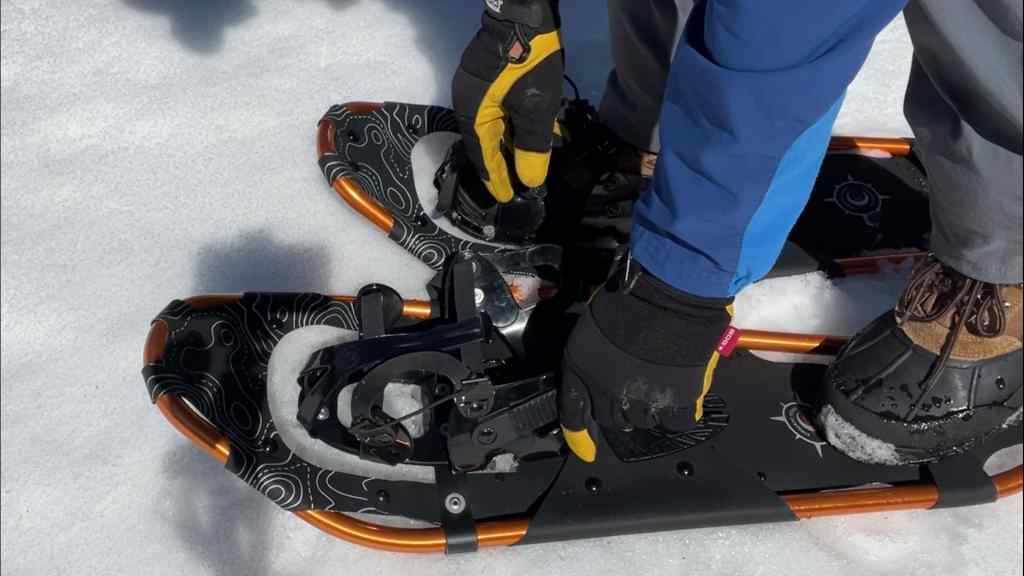
Women's-Specific Bindings
Many snowshoe manufacturers offer women's-specific binding systems that accommodate narrower feet and lower-volume boots common among women. These bindings feature narrower frames, different strap angles, and adjusted pivot points that match women's biomechanics. The closure mechanisms might be identical to men's versions (strap, BOA, or ratchet), but the overall geometry differs meaningfully.
Women with narrow feet or smaller boots often find women's-specific bindings fit more securely and comfortably than unisex or men's alternatives, regardless of closure type.
Kids' Binding Considerations
Children's snowshoe bindings prioritize ease of use for small hands, often with simplified strap systems featuring mitten-friendly adjustments. The Kids' Tyker and similar models employ simple, intuitive bindings that children can operate relatively independently, building confidence and reducing parental assistance requirements on the trail.
Making Your Binding System Choice
Assessing Your Priorities
Select binding systems based on your honest assessment of these factors:
Budget Reality: Can you justify BOA premium costs, or do value considerations favor straps or ratchets?
Usage Frequency: Occasional users (5-10 times per season) rarely miss premium binding convenience. Frequent snowshoers (20+ days) appreciate efficiency advantages daily.
Typical Conditions: Extreme cold environments favor glove-friendly BOA or ratchet systems. Moderate conditions where bare-hand operation is tolerable make straps viable.
Boot Transition Frequency: If you frequently put snowshoes on and off during trips, speed matters significantly. All-day wear without removal makes entry/exit speed less critical.
Sharing Considerations: Will multiple users with different boot sizes share these snowshoes? Strap versatility helps; BOA limitations might frustrate.
Testing Opportunities
Whenever possible, test different binding systems before purchasing. Many specialty retailers like Alpenglow Adventure Sports offer demo programs allowing hands-on experience with various binding types. The operational feel differs enough between systems that personal experience provides valuable insight beyond written descriptions.
Try putting snowshoes on while wearing the gloves you'll actually use. Attempt adjustments without removing the snowshoes. Evaluate whether the binding accommodates your specific boots comfortably. These practical tests reveal compatibility issues or unexpected preferences that specifications alone don't communicate.
Conclusion
Snowshoe binding systems fundamentally affect your daily experience on winter trails, from parking lot preparations through all-day comfort to end-of-day removal. Traditional strap bindings provide reliable, affordable functionality that serves recreational users admirably despite operational inconveniences. BOA systems deliver premium convenience, precision, and glove-friendly operation that serious snowshoers appreciate enough to justify costs. Ratchet mechanisms offer appealing middle-ground improvements over straps without BOA premium pricing.
The "best" binding system depends entirely on your specific priorities, conditions, and budget. Honest assessment of your actual snowshoeing habits—not aspirational fantasies—guides wise choices that enhance rather than complicate your winter adventures. By understanding each system's strengths and limitations, you can select bindings that match your needs and complement your snowshoeing style.
Ready to find snowshoes with binding systems perfectly suited to your winter adventures? Explore our comprehensive collection of snowshoes at Alpenglow Adventure Sports, featuring models with strap, BOA, and ratchet binding systems from trusted brands like MSR. Our knowledgeable staff—mountain specialists since 1986—helps you evaluate binding options and select snowshoes that deliver optimal performance, comfort, and convenience across your actual trail time. Get your gear to go and get outside with confidence in equipment that works exactly as you need it to!